
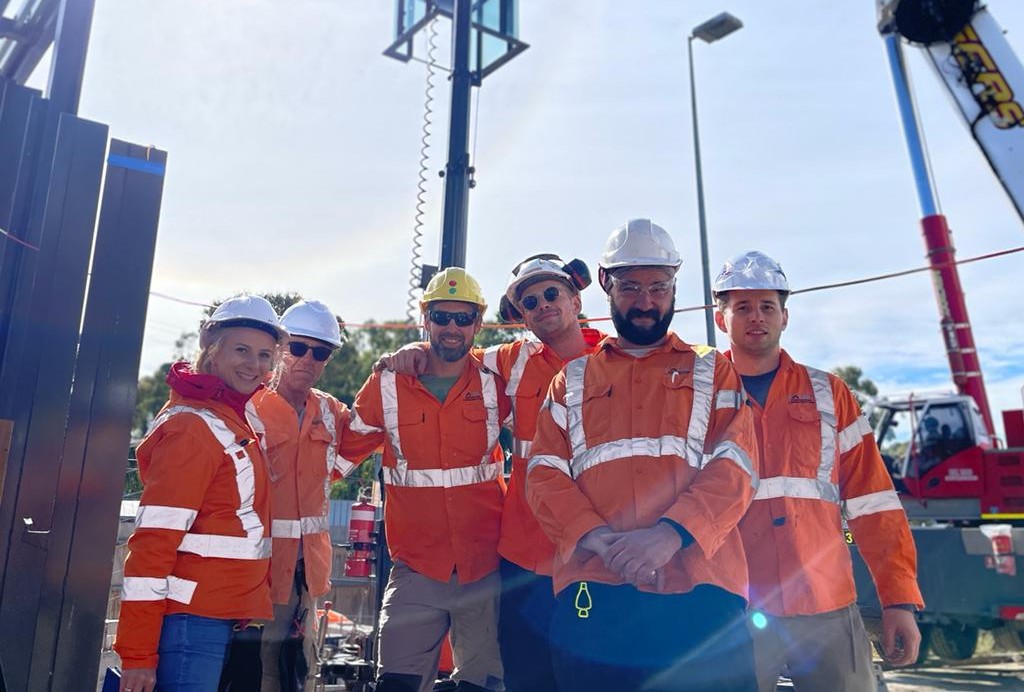
With ambitious plans to expand across the country, Sydney-based construction company Dalski is focusing on government contracts, and using ICN as part of its arsenal.
Established in 2003, Dalski is a specialist infrastructure engineering, procurement, construction and management company.
According to Business Development Manager, Jackson Sensicle, Dalski “operated very much as just a reliable, but , generic, low-level builder, with core revenues of about a million a year”.
However, when Jackson joined as a director in 2020 – just as COVID hit – the business began a revamp and growth that continues today. In fact, the company was able to employ people, and keep them employed, during the pandemic when much of the country shut down.
“We went back to basics,” he said. This included going through ISO and the Office of Federal Safety Commissioner accreditations to be able to bid on Australian Government contracts.
Dalski has also established a partnering business currently in the process of being Indigenously affiliated.
Last year, Dalski expanded permanently into Queensland and Tasmania, and has its sights set on the rest of the country in its five-year plan.
For the past few years, it has been working on a project for Snowy 2.0, a relationship that came about thanks to an EOI on ICN Gateway, that put Dalski’s name in front on the tier 1 contractors.
“I know that I only am a very small tooth on a very large cog on a project like Snowy. My first submission as a result of the ICN Gateway with Snowy was a $250,000 laundry building,” Jackson said.
“Once I was able to engage directly with the procurement team in Snowy it took me 18 months from the day I first engaged with them to being invited to submit a tender.
“What I am saying is the ICN Gateway provides a lot of opportunity, but you must be diligent and dedicated to longer term efforts.”
Since that original EOI submission, Dalski has delivered contracts worth more than $20 million to Snowy 2.0.
Jackson said he uses ICN Gateway to help understand what projects are coming up over the medium to long term.
“I can look at websites displaying all tenders due within the next four weeks.. This is such an effective use of my time, and , I can drum up work tomorrow,” he said.
“What Gateway does is it allows me to forward think, to look at what's going to happen 12 months, 18, five years, even.
“In my role, I have to look at today, look at the immediate future and then look at the long-term future. And I'm constantly throttling on or off depending on what's in the market.
“With Gateway I can look at what is coming up in the market, engage at the feasibility level, get to know who's who in the zoo and then travel through that journey as it goes from feasibility to a proper project.”
By engaging at the feasibility stage, and leveraging Gateway, Dalski develops the vital contacts to then be on the front foot when projects are approved and requests for tender are released.
Jackson uses the offshore wind projects currently on Gateway as an example of how he uses the platform to forecast and develop long-term plans for Dalski
“Having access to these large future projects, it doesn't matter to us that an offshore wind project may not actually go into construction for five or eight years,” he said.
“Because in five- or eight-years’ time, Dalski is a national business, and where we’ll sit in that project will be much higher as well.
“If that offshore wind project was to go tomorrow, we would be more limited in our capacity.”
Over the past year, Dalski has upgraded its Gateway subscription to premium, with a view to using the platform and ICN’s expert consultants to help him grow the business through getting more government contracts, including in the Defence sector.
Go to the Dalski website to find out more about the work it does.